
Stage 1 — Risk Assessment Before the Event
Before booking any security staff, assess the risk profile of your event. Ask yourself:
- How many guests are expected?
- Is alcohol being served?
- Are VIPs, celebrities, or public figures attending?
- What is the venue type — open ground, banquet hall, stadium?
- Are there any known sensitivities — political guests, rival groups, public controversy?
- What time does the event run until?
These factors determine the scale, type, and intensity of security required. A 50-person corporate dinner requires very different security to a 3,000-person outdoor concert.
Stage 2 — Calculate Your Guard Requirement
A general industry guideline for crowd management is one security guard per 100 to 150 guests for a controlled environment (banquet hall, conference centre). For open or outdoor events, especially those with alcohol, the ratio should be tighter — one guard per 50 to 75 attendees.
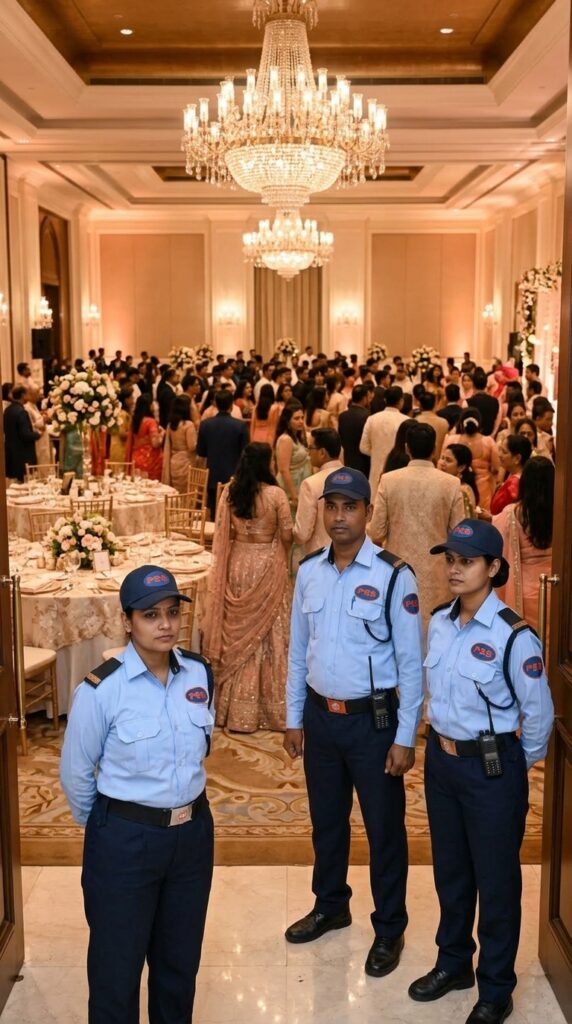
For events with VIPs, add dedicated close protection personnel on top of the general security requirement. For events requiring frisking, you need both male and female guards at entry points.
Never underestimate your guard requirement to save costs — one undertrained or insufficient security deployment can create a situation that causes reputational and legal damage far more costly than the guard budget.
Stage 3 — Venue Inspection and Security Planning
Your event security agency should conduct a venue inspection before the event. During this inspection, the security team should identify:
- All entry and exit points
- Restricted areas (backstage, VIP zones, technical areas)
- Emergency exits and evacuation routes
- Parking areas and their access management
- Any structural or sightline challenges
- On-site communication infrastructure
The inspection produces a security deployment map showing exactly where each guard is positioned, their zone of responsibility, and their supervisor contact.
Stage 4 — Brief the Security Team
Every security guard deployed at your event should be fully briefed before guests arrive. The briefing covers:
- Event timeline and schedule
- Guest profile and expected conduct
- Access levels (who can enter which area)
- VIP identification and movement routes
- Emergency procedures and escalation contacts
- Who to call if an incident occurs
A guard who has not been briefed is a guard who will make decisions based on guesswork during an incident. Invest 20 minutes in a proper pre-event briefing — it changes everything.
Stage 5 — During the Event
Security management during an event requires a designated supervisor — not just a team of guards. The supervisor’s responsibilities include:
- Monitoring all entry points simultaneously
- Communicating with guards across the venue via radio
- Making real-time decisions about crowd flow or access issues
- Coordinating with the event organiser and venue management
- Acting as the point of escalation if a guard encounters a situation they cannot resolve alone
Stage 6 — Post-Event Closedown
Event security does not end when the last speech finishes. Post-event responsibilities include:
- Managing guest departure (orderly exit, parking flow)
- Sweeping the venue for any remaining guests or unauthorised persons
- Securing the venue until handover to the venue management
- Documenting any incidents that occurred during the event
Ask your security agency for a written incident report after the event — even if everything ran smoothly. This record protects you if any post-event claim arises.
PSS Security Solutions provides professional event security for weddings, corporate events, concerts, and exhibitions across India. Call +91 9811110734 for a free event security consultation.